7.1. DNS-aware Network Policy
Task 7.1.1: Create and use a DNS-aware Network Policy
In this task, we want to keep our backend pods from reaching anything except FQDN kubernetes.io.
First we store the backend Pod name into an environment variable:
BACKEND=$(kubectl get pods -l app=backend -o jsonpath='{.items[0].metadata.name}')
echo ${BACKEND}
and then let us check if we can reach https://kubernetes.io and https://cilium.io:
kubectl exec -ti ${BACKEND} -- curl -Ik --connect-timeout 5 https://kubernetes.io | head -1
kubectl exec -ti ${BACKEND} -- curl -Ik --connect-timeout 5 https://cilium.io | head -1
# Call to https://kubernetes.io
HTTP/2 200
# Call to https://cilium.io
HTTP/2 200
Again, in Kubernetes, all traffic is allowed by default, and since we did not apply any Egress network policy for now, connections from the backend pods are not blocked.
Let us have a look at the following CiliumNetworkPolicy:
---
kind: CiliumNetworkPolicy
apiVersion: cilium.io/v2
metadata:
  name: backend-egress-allow-fqdn
spec:
  endpointSelector:
    matchLabels:
      app: backend
  egress:
    - toEndpoints:
        - matchLabels:
            "k8s:io.kubernetes.pod.namespace": kube-system
            "k8s:k8s-app": kube-dns
      toPorts:
        - ports:
            - port: "53"
              protocol: ANY
          rules:
            dns:
              - matchPattern: "*"
    - toFQDNs:
        - matchName: kubernetes.io
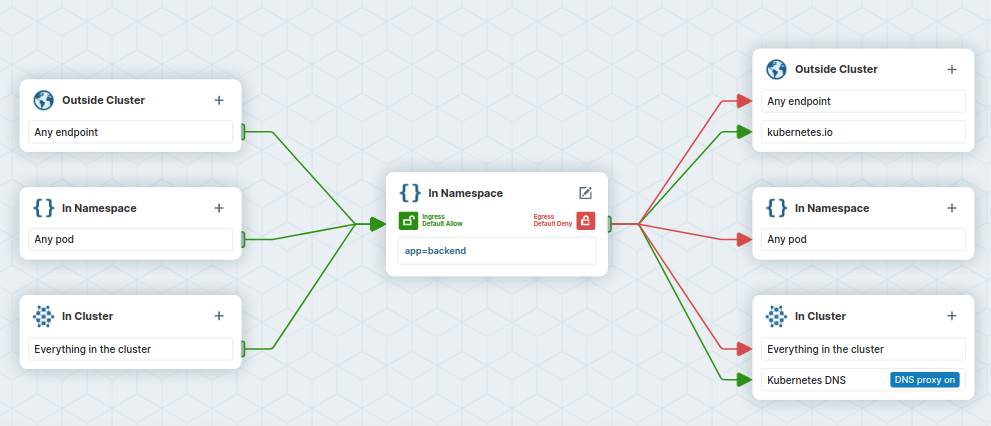
The policy will deny all egress traffic from pods labeled app=backend except when traffic is destined for kubernetes.io or is a DNS request (necessary for resolving kubernetes.io from coredns). In the policy editor this looks like this:
Create the file backend-egress-allow-fqdn.yaml with the above content and apply the network policy:
kubectl apply -f backend-egress-allow-fqdn.yaml
and check if the CiliumNetworkPolicy was created:
kubectl get cnp
NAME                        AGE
backend-egress-allow-fqdn   2s
Note the usage of cnp (standing for CiliumNetworkPolicy) instead of the default netpol since we are using custom Cilium resources.
And check that the traffic is now only authorized when destined for kubernetes.io:
kubectl exec -ti ${BACKEND} -- curl -Ik --connect-timeout 5 https://kubernetes.io | head -1
kubectl exec -ti ${BACKEND} -- curl -Ik --connect-timeout 5 https://cilium.io | head -1
# Call to https://kubernetes.io
HTTP/2 200
# Call to https://cilium.io
curl: (28) Connection timed out after 5001 milliseconds
command terminated with exit code 28
Note
You can now check theHubble Metrics dashboard in Grafana again. The graphs under DNS should soon show some data as well. This is because with a Layer 7 Policy we have enabled the Envoy in Cilium Agent.With the ingress and egress policies in place on app=backend pods, we have implemented a simple zero-trust model to all traffic to and from our backend. In a real-world scenario, cluster administrators may leverage network policies and overlay them at all levels and for all kinds of traffic.
Task 7.1.2: Cleanup
To not mess up the proceeding labs we are going to delete the CiliumNetworkPolicy again and therefore allow all egress traffic again:
kubectl delete cnp backend-egress-allow-fqdn